August 25, 2026
In the summer of 2022, just a few weeks before starting Hampshire College, Rue began using a wheelchair. Rue had been working at Girl Scout camp, work that was incredibly rewarding but also physically taxing for a young person with an autoimmune syndrome.
“It was a huge adjustment to start college while learning to use a wheelchair,” Rue reflects. “Also, my first wheelchair came from Amazon, and it was nearly impossible to use.”
On campus, another wheelchair user saw Rue struggling. That hospital-style wheelchair from Amazon was workable indoors, but Rue had to get out and push it from building to building.
“[She] came up to me and said, ‘Hey, I just want to let you know, I got my wheelchair from this program.”
The older student, Rue figures, was REquipment’s Hampshire College “Client Zero.” That’s because Rue would go on to found Hampshire’s Disabled Student Union and share REquipment listings with many students.
“After I got my manual chair from REquipment, I kept checking the website pretty regularly because I knew so many people who were in need of equipment.”
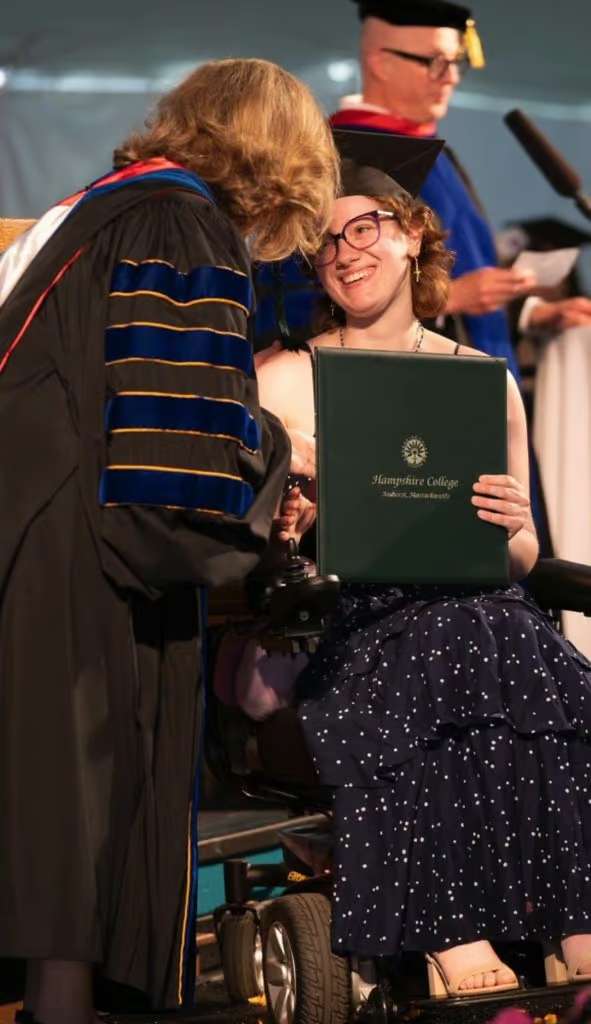
By graduation, two of Rue’s roommates in disabled student housing were also using wheelchairs from the program. Other students they knew acquired rollators and bath chairs.

REquipment rarely learns the stories of the wheelchairs delivered to college campuses or what their users go on to accomplish. Learning the life-changing impact REquipment had at Hampshire College is powerful. Rue’s story illustrates the importance of timely access to essential equipment at an important developmental moment.
For example, Rue minored in Theater.
The manual wheelchair REquipment provided spent considerable time on the stage.

It also bridged months of waiting for a custom insurance-provided wheelchair, a chair Rue would eventually equip with a SmartDrive. Access ramps and campus hills became too difficult for Rue without a power assist.
Unfortunately, the SmartDrive took a year to acquire, was recalled twice, and then broke down.
By December of 2025, Rue was stuck again.
Again, Rue would need REquipment.
A decline in their health compounded the problem. Rue spent 18-20 hours in bed each day that fall, tolerating short outings only a few times a week. It was a terrible way to start senior year.
“I spent about two months almost never leaving the house. Watching other people your age go to parties while you’re struggling to leave the house at all is really hard.”
Winter break was the worst.
“I was working on my thesis project and needed regular meetings with my advisors. I had to do all the meetings virtually, which is not the same as sitting down across from someone.”
In January, Rue finally secured an appointment at Spaulding for an evaluation for a power wheelchair or a power assist operated with a joystick. It took Rue the whole day to travel from Western Mass to Boston.
“It was hard for me to do because I don’t drive. Yet, immediately they were saying, ‘I just watched you roll into the room in your manual chair. There’s no way your insurance is going to cover a power chair.’”
Rue protested: “But we’re in a building! It’s flat. There’s tile. There are so many variables that are making this possible for me!”
Spaulding’s clinicians explained insurance will only approve a wheelchair for use at home.
Rue was devastated. What about finishing college? Getting a job? Going out with friends?
“It kind of felt like my life was ending,” Rue says.
That’s when Rue saved REquipment to the home screen on their phone.
“I checked the listings probably two or three times a day.”
In March, their diligence paid off.
An Elite ES from Pride Mobility, a basic power wheelchair with a joystick controller in excellent condition, showed up in the REquipment program’s online inventory.
No insurance necessary. No prescription needed.
REquipment delivered it two weeks after receiving Rue’s request. The cost?
$20 for delivery.
Rue was back in action.
Now Rue could get their own mail instead of asking a friend to do it. They could make it up hills and access ramps they couldn’t manage before. They could go grocery shopping. And because the power chair was controlled with a joystick, Rue had one hand free to use their phone—one of the biggest advantages to driving a power wheelchair.
There was one downside. Rue noticed more stigma when using a power chair. People made less eye contact.
Still, Rue says, “REquipment changed everything for me.”
That spring, Rue was completing not one but two major academic projects to complete their degree. For theater, they analyzed disability representation in Wicked, focusing on characters including Nessarose and Elphaba. For their Disability Studies major, Rue conducted a research study on experiences with disability in the K–12 education system and used the results to create a professional development curriculum for educators.
Rue completed those projects. Rue met the demands of senior year.
As of this writing, Rue has been waiting eight months for their SmartDrive to be repaired. “I will appreciate having my SmartDrive back,” Rue says, “but SmartDrives are designed for long distances. Often I need a power assist for tight maneuvering.”
Rue will keep their REquipment-provided power chair.
They hope someday every state will have a reuse program as accessible as REquipment. While the Assistive Technology Act supports reuse activities nationwide, few states have a website to browse for available no-cost devices. “It’s hard to know where to refer people who live out of state,” Rue observes.
Rue is enormously grateful for REquipment in Massachusetts. Their Elite ES was cleaned, sanitized, and received new batteries. Every chair accepted for donation by REquipment gets this treatment. It was also in excellent condition. Rue expects it will serve them for years to come in the community and at work as a college graduate.
“Insurance didn’t care if I finished college,” Rue reflects, “REquipment did.”