September 24, 2026
REquipment has been getting an education lately in just how much our reuse program means to college students in Massachusetts.
Last month, we highlighted Rue’s journey at Hampshire College—from struggling with a manual wheelchair to receiving a power chair from REquipment that she credits with making her graduation possible.
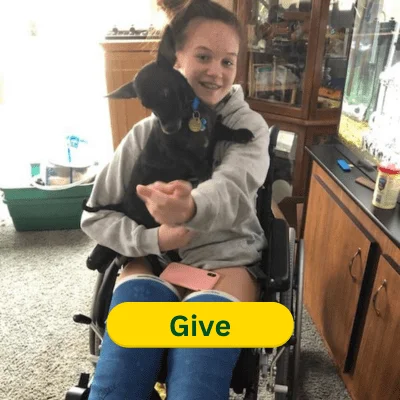
This month, REquipment is highlighting Sarah, a recent graduate of UMass Amherst, where REquipment also helped keep her education on track.
Finding Community, Finding REquipment
Growing up, Sarah had a complicated relationship with disability.
“I was born with a very mild visual impairment where I kind of stood on the fence. I didn’t see myself as fully belonging on either side,” she says.
When Sarah arrived at college, she soon made friends who were members of the Disability Culture Club.
“But I didn’t feel comfortable jumping in.”
Then, halfway through her first year, Sarah had surgery for an injury and learned that a genetic condition was causing her increasing difficulty walking. This change in her mobility brought her into the fold.
“One Friday, when my health was getting worse, my friends were like, ‘Just come with us. It’s Friday night. You’re coming with us.’”
That turned out to be a pretty important Friday night.
Time with her Disability Culture Club peers helped Sarah accept her disability and seek the accommodations and durable medical equipment (DME) she needed. She also began listening to her dormitory RA when they suggested she move into accessible student housing.
Crawling up the stairs each night, she finally agreed, just wasn’t cutting it.
At the time, Sarah needed a manual wheelchair, but insurance would take six months to provide one. She was 19 and trying to stay in school.
Thankfully, her new peer community introduced her to REquipment.
On the REquipment website, Sarah found a free, refurbished manual wheelchair. It was delivered for $20 and kept her getting to classes. She also requested a rollator.
“It was life-changing to not have to suddenly uproot my plans at age 19 and drop out,” Sarah says. “I didn’t have to put my whole life on hold waiting for a wheelchair.”
Equipment That Keeps Giving
Sarah’s REquipment story could end there. But REquipment devices have gone on to lead surprisingly full lives, both on campus and at home.
Her dad borrows her rollator when his sciatica flares. Her manual wheelchair has been used by several family members since her insurance came through.
And then there’s “Beep Beep,” a REquipment-provided power wheelchair that, for a time, became something of a mascot at the UMass Disability Culture Club.
Sarah isn’t entirely sure who had it first, but different students have used Beep Beep at one time or another, Sarah included.
She smiles impishly when she talks about Beep Beep. She recalls a modification she made with a zip tie that overrode the speed limiter for functional reasons (she insists), but also, “Well, when in college…”
Beep Beep, it seems, also served as a joy ride in the club basement. And there may have been some wheelie-learning sessions.
“Even disabled students gotta have their stupid moments,” Sarah laughs with affection.
Program note: REquipment does not in any way condone or sanction overriding safety features of durable medical equipment. However, we do understand the developmental moment. (Some of us may have taken a joy ride or two…)
The Disability Culture Club describes its spirit this way:
“We’re here to celebrate all brains and all bodies. We’re here to celebrate the diversity of human experience. We won’t be assimilated, and we won’t tolerate pity. Come party with us!”
— Disability Culture Club, UMass Campus Pulse
From REquipment to a Campus Loan Closet
All this equipment sharing, however, led to something more lasting. The Disability Culture Club has turned these early DME experiences into a grant-funded project: a mini campus DME loan closet.
Students can now borrow forearm crutches, canes, a rollator, a wheelchair, and other equipment, along with information resources. Instead of assuming one mobility device is right for them, they can try different options and learn what works before acquiring their own.
For Sarah, these experiences reinforced not only the power of DME and assistive technology but also the power of her peer community.
Paying It Forward
This summer, Sarah worked as a mentor with Roadmap to College, a Polus Center program that works with young people referred by the Massachusetts Commission for the Blind. The program introduces high school students to college opportunities and communities.
It’s a fitting role for a young woman who understands firsthand the importance of learning from peers what is possible—peers who can help students see college as a possibility and themselves as belonging there.
After all, it was other UMass Amherst students who helped Sarah accept her disability, seek accommodations, and access REquipment so that a six-month insurance process didn’t become a six-month interruption to her education.
Now the effects of that empowered community continue rippling outward.
REquipment’s Surprising Legacy
One of Sarah’s Disability Culture Club friends—the RA who convinced her to apply for accessible housing—has gone on to work at Stavros Center for Independent Living, an REquipment program partner.
Jem fixes wheelchairs as part of the new Medicaid wheelchair repair program pilot.
This news couldn’t make REquipment prouder: Jem is also one of our Jennifer Baker Scholarship recipients.
And Sarah?
Armed with her degree in music education, Sarah is currently student teaching and leading by example.
Congratulations, Sarah. REquipment is proud as a peacock to have played a role in your success. And we’re delighted to think of all the lives you’ll touch going forward.